Wednesday, January 2, 2019

The Glacier Priest


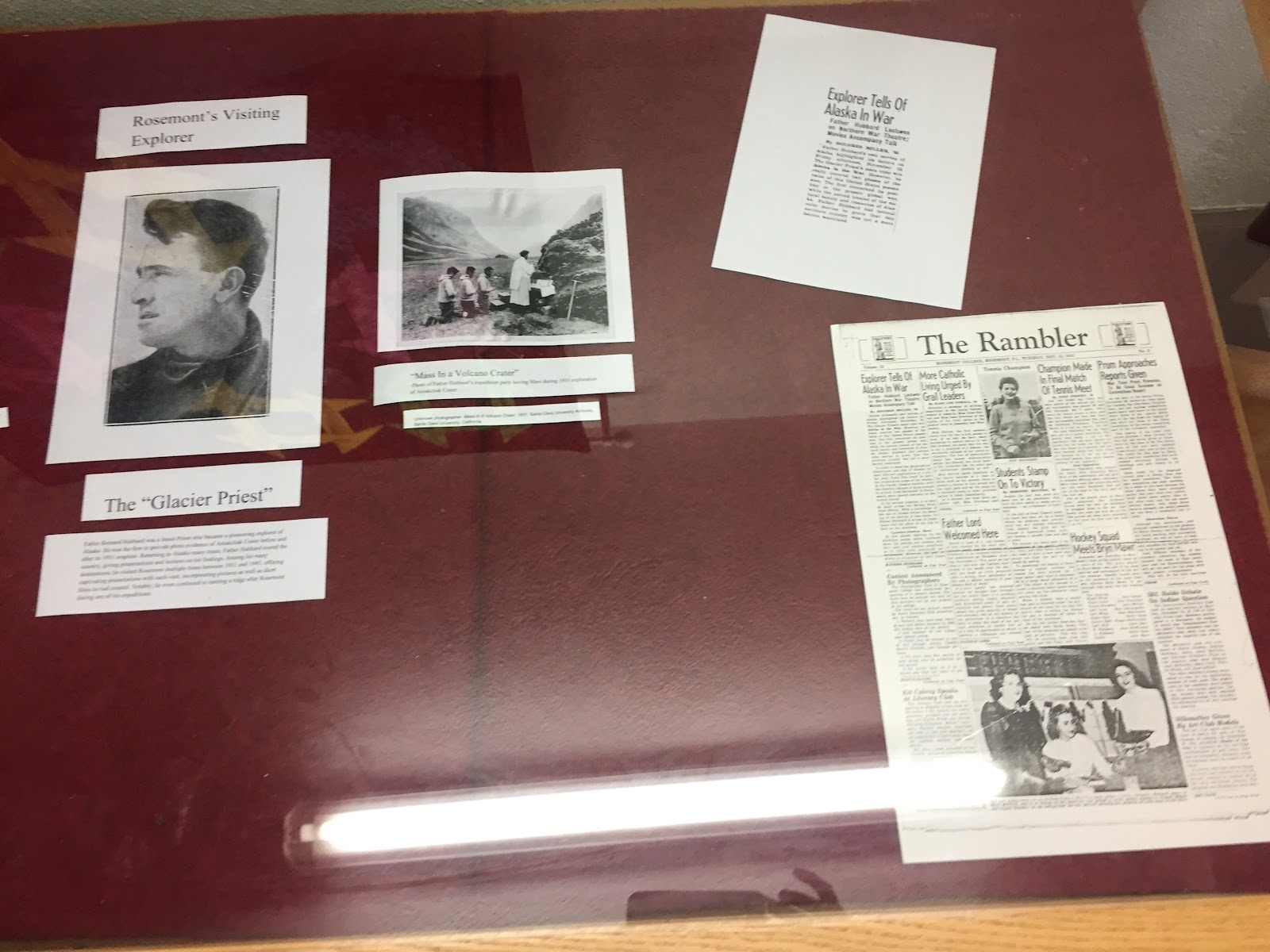
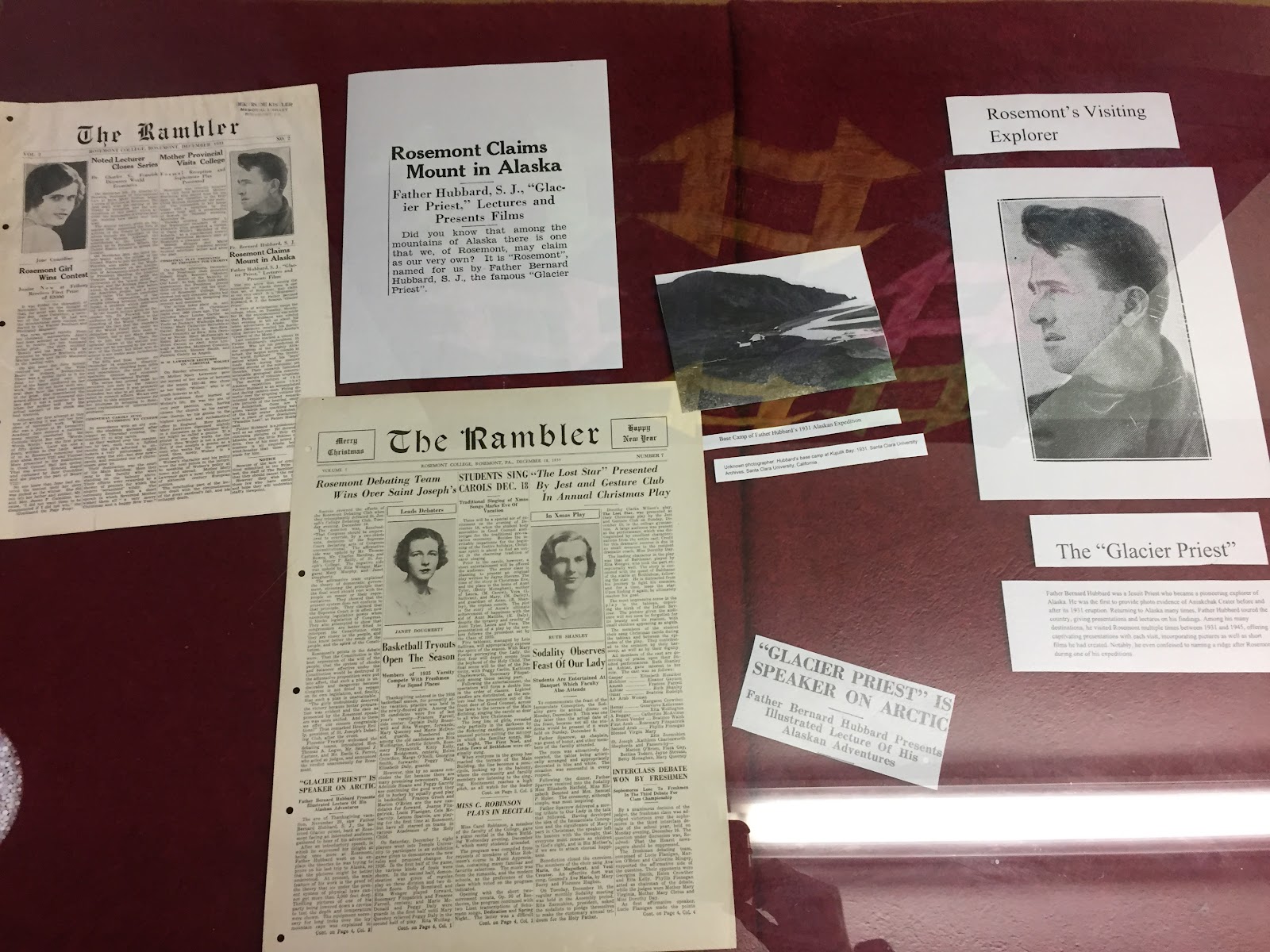
Imagine Mass celebrated on a glacier. That is just one of the remarkable feats of the subject of our current archives exhibit, Father Bernard Hubbard, S.J., a missionary and explorer to Alaska in the 1930’s and 40’s.

Archives intern, Josh Slater, was inspired to create this exhibit through his work indexing the student newspaper, The Rambler. He was surprised to find the phrase “The Glacier Priest” several times during this project. This was enough to pique his interest.

When he wasn’t exploring Alaska, Fr. Hubbard toured the continental U.S., speaking at colleges about his travails. He was a pioneer in multimedia presentations, showing photos and film of his team’s endeavors and demonstrating mountaineering equipment. The dashing priest spoke at Rosemont five times. His presentations generated much excitement at the college particularly when he announced that he’d named an Alaskan ridge “Mount Rosemont."

Josh was impressed with Fr. Hubbard’s:
“...determination and enjoyment of his expeditions. He did not have to keep returning to Alaska, and did not have to research it. Even when the scientific community stated that he had accomplished little of value, he continued to travel and speak on it, because he wanted others to know just how amazing it was.”

Come see for yourself how amazing it was. Visit the Archive’s Exhibit Case by the Main Floor Stacks.

Bonus: The exhibit contains 2 original copies of The Rambler, one of which shows a photo of Patricia Kennedy (of the Kennedy family) as a tennis champion.

Wednesday, March 28, 2018

Archiving Abroad: Archives in Jos, Nigeria


Emily Siegel, Archives assistant, had the opportunity to travel to Nigeria to help the train the Sisters there in archival work. We are so excited for her to share her knowledge with us. There is an exhibit of her experience in the Archives exhibit space on the main floor of Kistler Library.

In October 2017, I was welcomed by the Sisters of the African Province of the Society of the Holy Child to visit their communities in Nigeria and to train a few Sisters in how to complete archival work in connection with my archival work here for Rosemont College and the American Province Archives of the Society of the Holy Child.

(Chapel on the Society of the Holy Child compound in Jos)

In Jos, I stayed on a compound that houses the novitiate, the Archives office, and the Center for Renewal, a retreat center.  (A novitiate is a place where an individual who desires to enter religious life lives before taking vows so they may discern whether or not they feel called to this way of life.)

I spent all of my waking hours with the community of Sisters and novices. It was a pleasure to live with the novices because it gave me the opportunity to get to know the young women who desire to become Holy Child Sisters. At the time there were 13 novices living there who came from various locations in West Africa. Some of them were from local tribes near Jos, others were from other parts of Nigeria (both east and west of Jos) and there were a few from Ghana, another location in West Africa where the SHCJ are present. I was warmly welcomed by everyone I met and they were just as eager to tell me about their own homes and culture as they were to learn about my own. They were such a welcoming group that I never even had the opportunity to be homesick.
(The Novices! L to R standing: Celine Ezeoke, Patience Muoto, Bernadine Ekeh, Louisa Ayirah, Mercy Duru, Philomena Sam, Victoria Ikwen, Euphemia Igwe, Marcy Oveghawo, Mary Aker  
Kneeling L to R: Chinyere Ugwoke, Augustina Ayinga, Veronica Akumsiyiga)

During the day I spent my time working in the Archives helping and educating four SHCJ sisters (The African Province Archivist, Sr. Juliana Onyeoke, Sr Calistar Igbo, Sr Elizabeth Njoku and Sr Chinyere Nwafor ) in how to properly archive materials. We were collectively tasked with organizing the disheveled collections of papers, photos, and other documents. I showed the Sisters the best techniques for working in Archives and then we all worked together to implement them. The Society’s presence in West Africa dates back to 1930 so this was an amazing opportunity to work with materials that dated back to that time period. It was also exciting for the Sisters to work there because in many ways this history was something they only previously had been taught by word of mouth.


While I was in Jos, the Society celebrated their foundation day, the day that the Society of the Holy Child Jesus was founded in Derby, England on October 15, 1846. It was wonderful to enjoy the Africans' take on such a celebration and it gave me the opportunity to meet SHCJ Associates local to Nigeria.


It was such an honor to have the opportunity to get to know the Society in West Africa and to be able to help the Sisters learn the best techniques for saving their own history. Everyone I met made me feel so welcome and at home in a place so different than the east coast of the United States.  


Here are some more pictures of the compound and photos of Jos.


Wednesday, January 10, 2018

Changes at the Library Part 2

So here is so more exciting news from GKML:

Wireless printing has come to the Kistler Library! Now you will be able to print from your personal devices to the library printer. The process is easy for everyone, no apps to download or passwords to remember, just use your Rosemont email to email your document to our printer. This new service just started yesterday and we have had positive feedback from all who have tried it. Just imagine how much easier this will make printing for you this semester. Visit the library to try out this new service today. If you need help ask a librarian.

Tuesday, January 9, 2018

Changes at the library Part 1


As Break winds down, things are getting busy here at the library. We have many new and exciting changes that have occurred over break and hope that you will be as excited about them as we are. Over the next few days, we will be sharing the changes with you here and on our other social media accounts.
LexisNexis is now Nexis Uni and has many updated features that improve the database for students and faculty use. Paging all students: before the semester kicks off, be sure to check out Nexis Uni—an exciting new research solution designed with and for digital natives like you. Nexis Uni enables quick discovery across all content types, personalized discipline pages for those who set up individual profiles and a collaborative work space for group assignments. Start the semester at an advantage—contact a librarian today for a quick demo.

Thursday, November 16, 2017

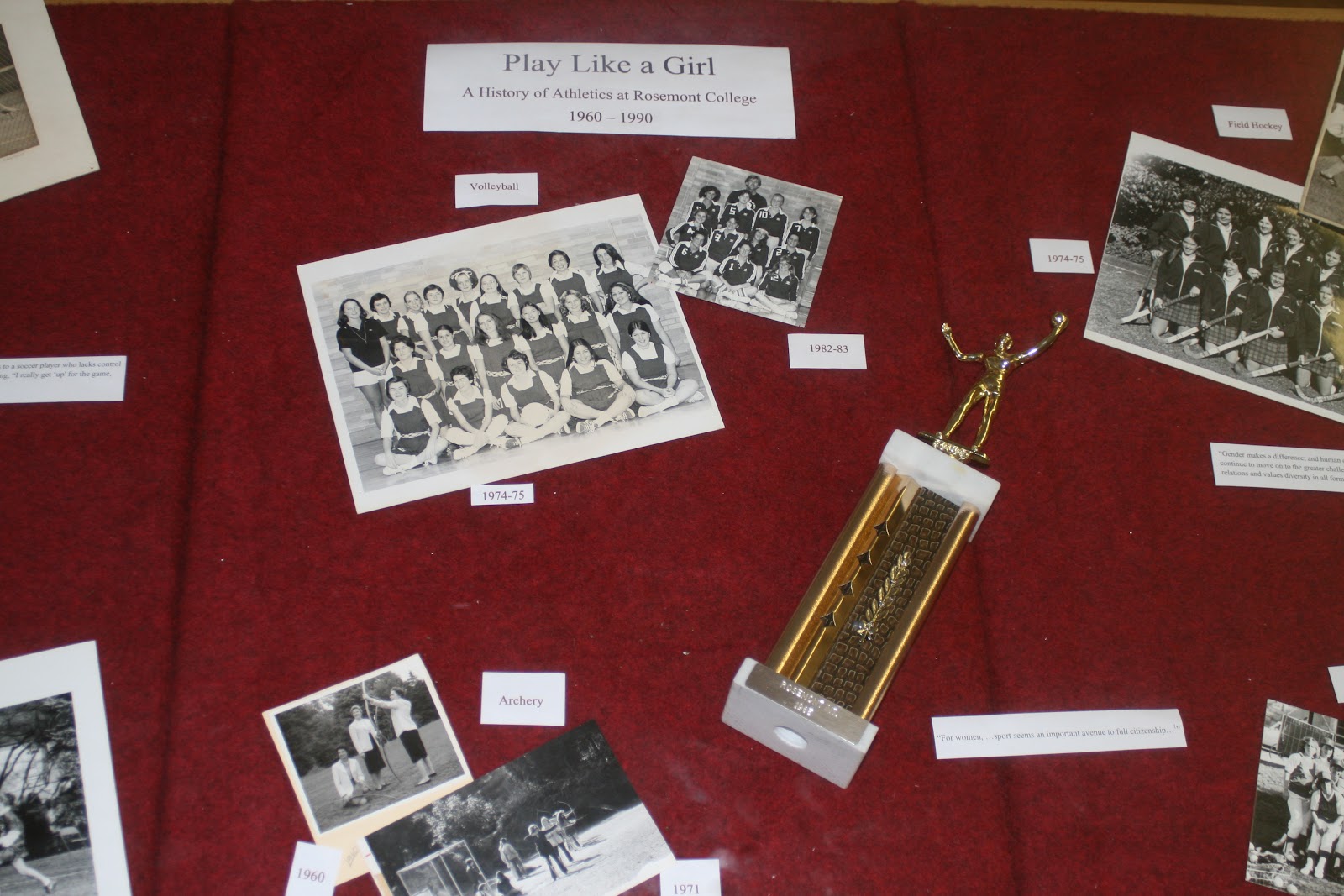
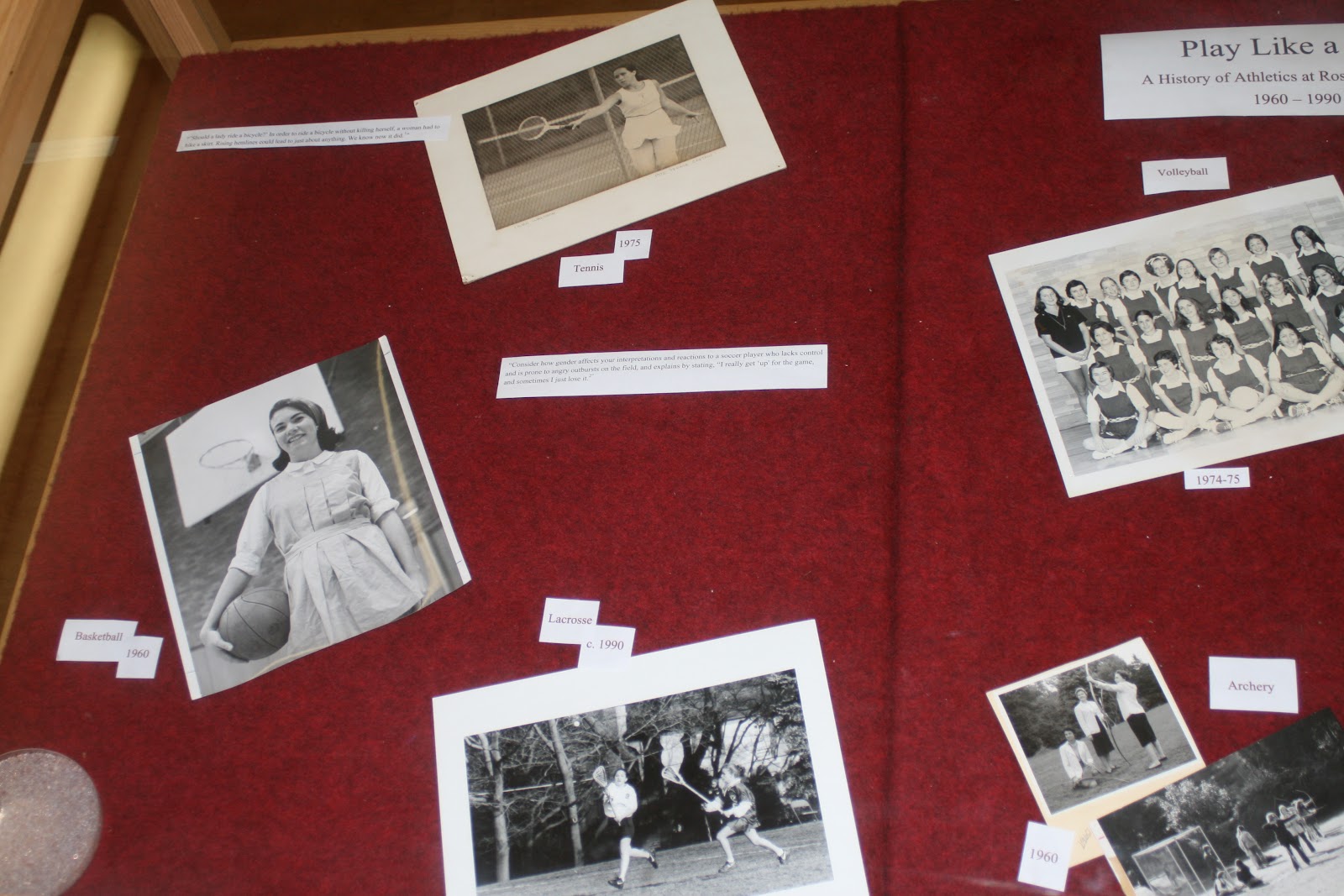
Play Like a Girl: A History of Athletics at Rosemont College, 1960-1990

Play Like a Girl: A History of Athletics at Rosemont College, 1960 - 1990

IMG_7327.JPGThis is the second of what I hope will be 3 exhibits on athletics at Rosemont. Archives Assistant, Emily Siegel, ‘14, curated the first part of this exhibit, which portrayed Rosemont athletics from 1923 - 1960. It showed that women’s colleges were places where women could be athletic, in a safe, accepting environment, during a time when this may have been frowned upon in other places.This was eye-opening to me.


IMG_7328.JPG
I had a similar realization over the summer, when I saw the movie Wonder Woman. I was moved by its portrayal of strong, athletic women, which was not salacious. I hadn’t realized the novelty of this image until I saw it there. Diana and her sisters enjoyed their athleticism and physical strength. They were confident in it. I wanted to select photos of Rosemont students who were enjoying themselves, strong and proud and excelling in sports; who displayed the same attributes as those fictional women.

The 60’s saw many advances in women’s rights. Title IX was enacted in 1972. Yes, we’ve come a long way, but women still strive to be taken seriously in the sports arena (and in others). I hope that this series of exhibits will encourage further thought and discussion on that subject within the Rosemont community.

Elena Sisti

Tuesday, November 14, 2017

Dr. Gold's Connelly Lecture

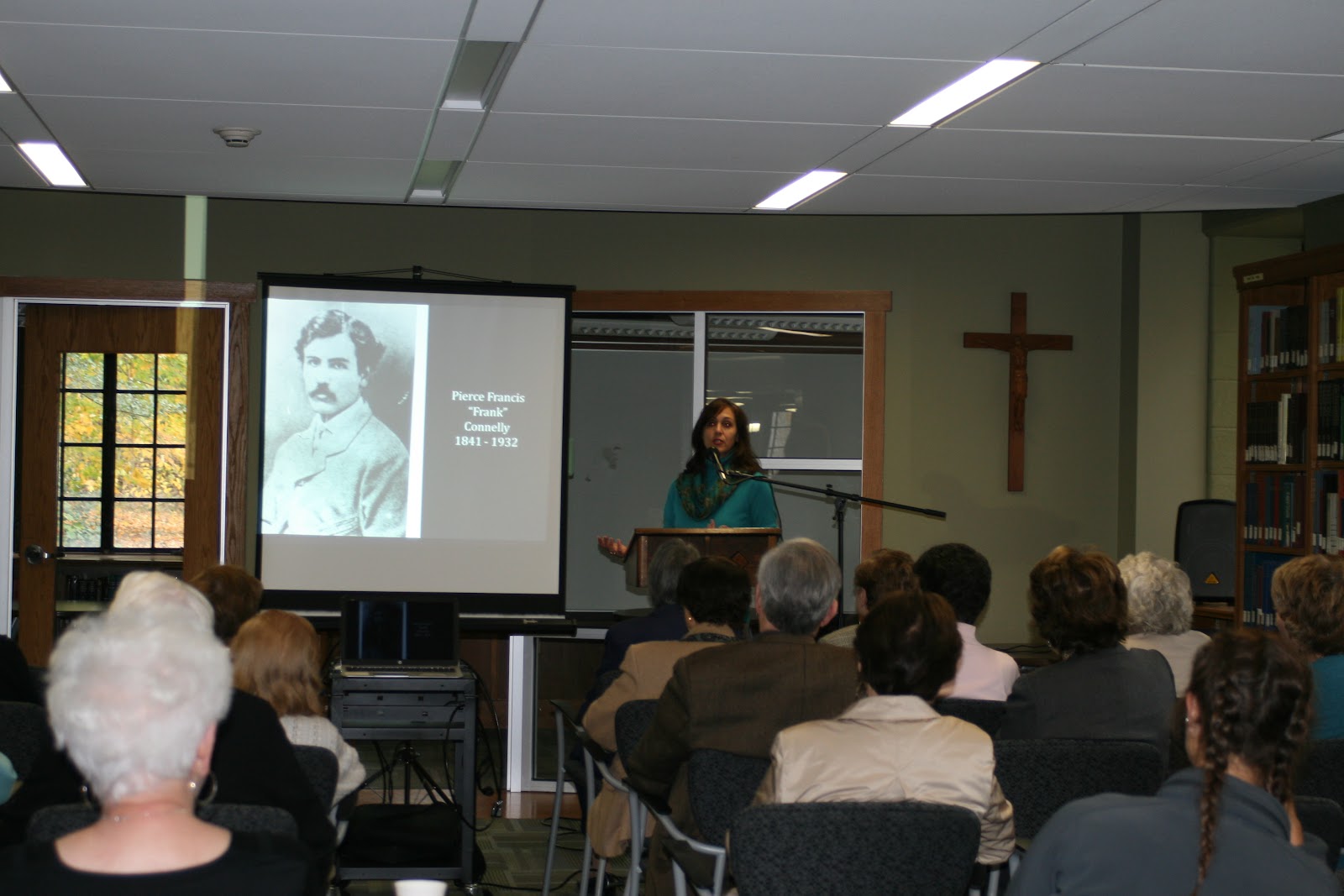
Pierce Connelly lecture 001.JPGOn Wednesday, November 1, we had the distinct pleasure of hosting Dr. Susanna Gold at the Gertrude Kistler Memorial Library at Rosemont College. She gave an informative lecture on the works of Pierce Francis “Frank” Connelly, son of Cornelia Connelly who was the foundress of the Society of the Holy Child of Jesus.

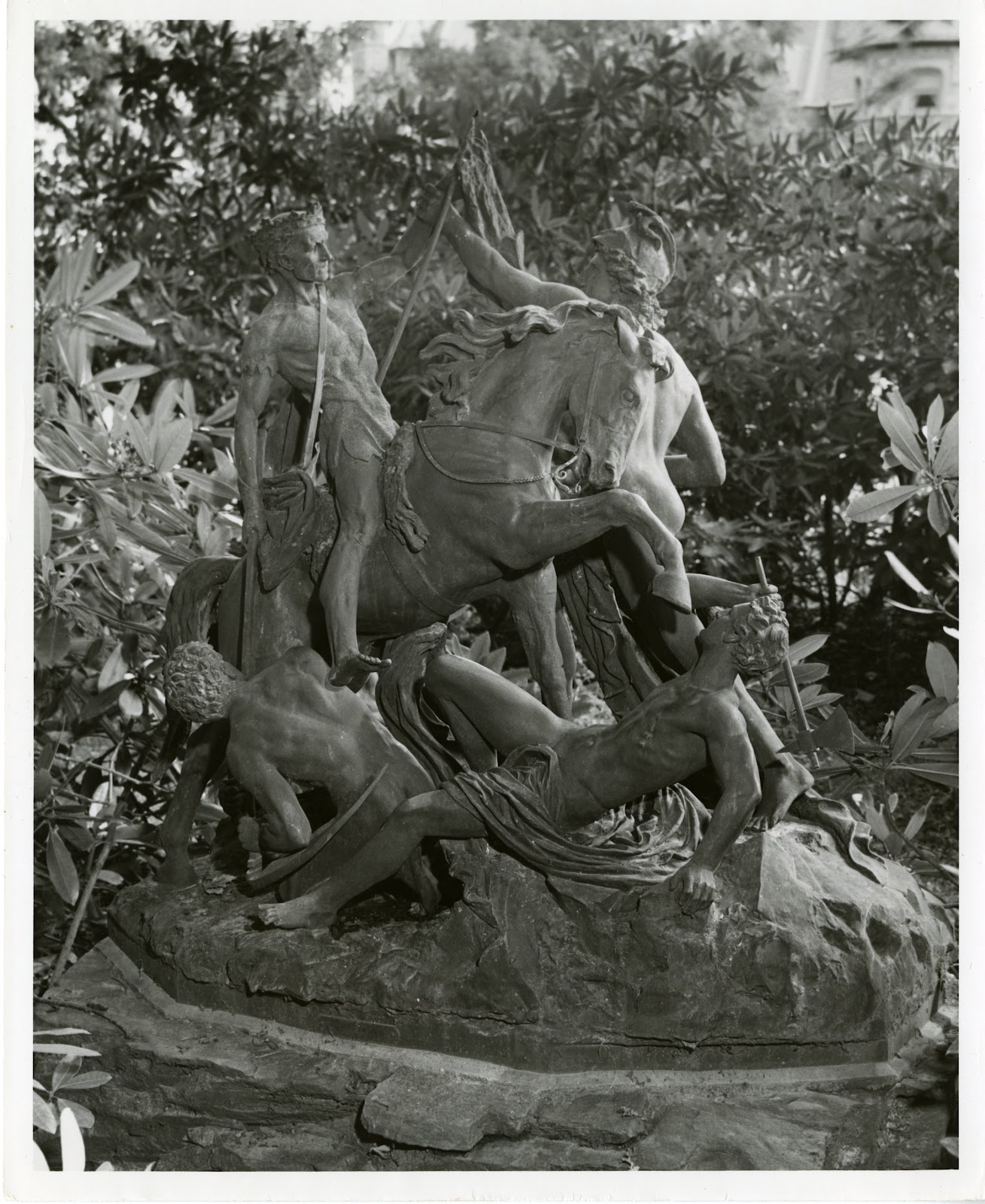
Dr. Gold laid out Frank’s journey through the arts in Italy as well as his entrance into the Centennial Exhibition in Philadelphia, PA in 1876. She discussed his works of art that were on display prominently at the Exhibition. The piece that drew the most interest was very different from the rest of Frank Connelly’s work. Most of his sculptures were neoclassical style, women sculptures, while the piece that was the focus of the talk was much different.  "Honor Arresting the Triumph of Death," is a group composition that features six different figures:  Death, Death’s horse, Strength, Courage, Perseverance and Hope. Dr. Gold discusses how this piece, unlike others at the exhibit that portrayed aspects of the Civil War in the United States of America, touched everyone and allowed for the focus on the sacrifice of human life rather than the sides of the war. Most of Connelly’s work was sold at this exhibition Dr. Gold noted, except for this one piece.  

An article in The Rambler relays the story of how the sculpture came to Rosemont college. In the summer of 1939, Rev. Mother Provincial and Rev Mother Ignatius traveled to Rome where the meet Frank's daughter, Mariana who later became Princess Borghese. She felt that the sculpture should be in the hands of the Society of the Holy Child Jesus and gifted it to Rosemont College. The sculpture has been in various places on the campus and is currently close to the science building.

If you would like to learn more about Frank Connelly or his work, schedule an appointment with our archives department or you can check out Dr. Gold's book The unfinished exhibition: Visualizing myth, memory and the Civil War in centennial America from the Gertrude Kistler Memorial Library.

Unknown. (1939, October 13). Princess Borghese presents statue: Group was executed by F.P.

Connelly. The Rambler.

Wednesday, October 4, 2017

In the Spotlight: Archives Presents at CIC Conference in Washington, D.C.

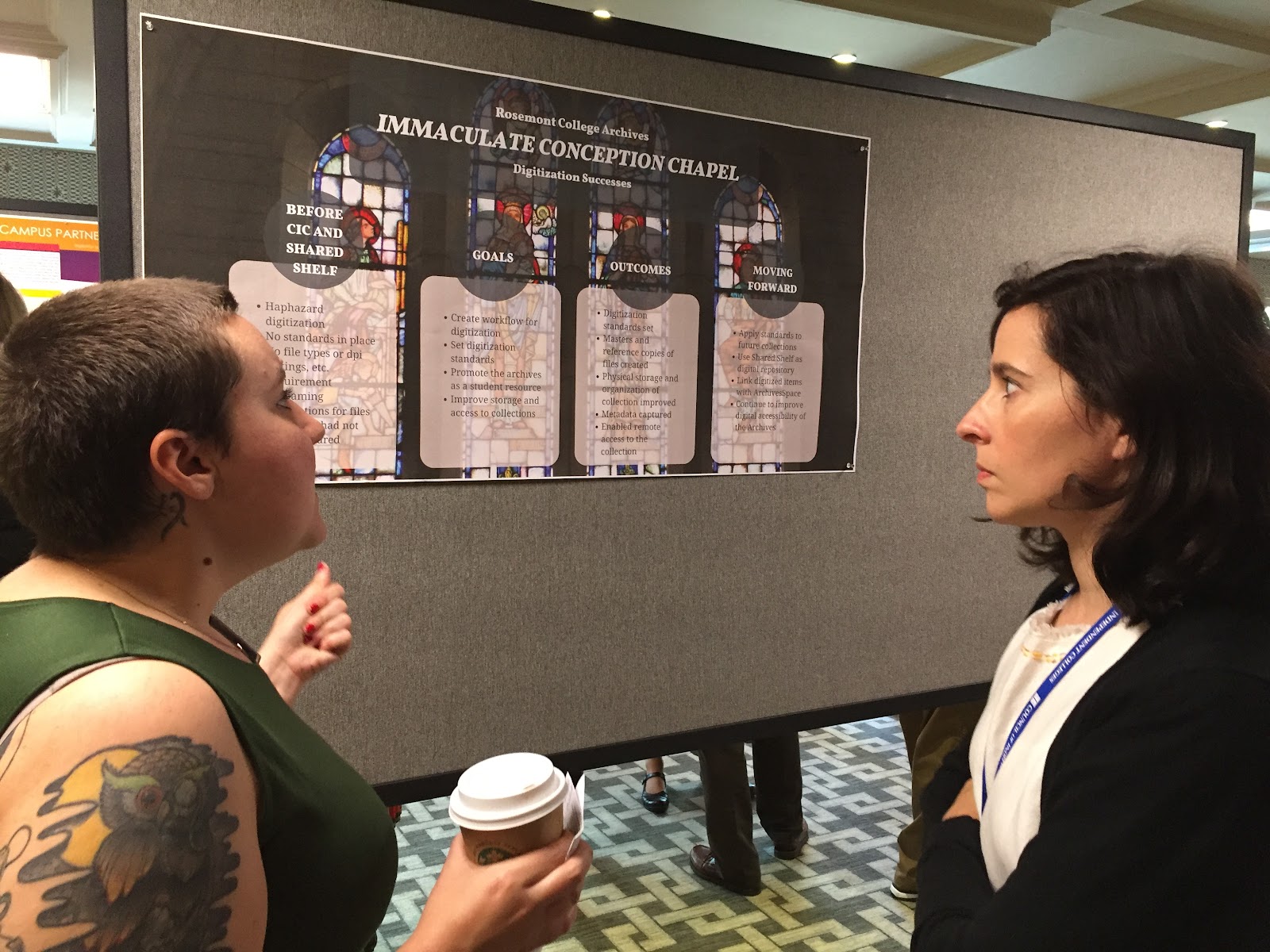
IMG_2115.JPGIn September, Archives Assistant,  Emily Siegel, '14 presented a poster at The National Workshop of the Consortium on Digital Resources for Teaching and Research in Washington, D.C. During the last three years, the Rosemont College Archives has worked with the Council of Independent Colleges (CIC) through a grant provided by the Andrew W. Mellon Foundation to digitize the archival records pertaining to the college's Immaculate Conception Chapel. The Immaculate Conception Chapel is significant to Rosemont College’s history because it is one of a very few across the United States that features specifically female saints. We want to get that information out to the world!

This project came about after a group of students participating in a Digital Humanities class in the Spring of 2014 began researching the construction of the Chapel. This class focused on building a website based on the construction of the College’s Chapel by collaborating with the Archive staff and using the archival materials that were a part of the Chapel Collection. During this process, the Archive staff realized that there was a need to have these items digitally preserved to aid in preservation and make them accessible online so that students didn’t necessarily have to be in the Archives in order to complete their research. Digitization is a big part of preservation in any archive. It ensures that duplicates of photos, documents, and other items are being saved so that if anything ever happened to the original copy we have a backup file to support the collection. Digitization projects also help us to see what in the collection might need extra attention in terms of preservation. Also, with the students building a website there was the desire to display some of the photos and documents online.

The goal of this project was to allow greater access to the documents without researchers having to handle some of the more delicate items. The documents have been scanned into a program called Shared Shelf and are now accessible to anyone who has interest in viewing them without having to make an appointment with an archivist at Rosemont. The Archives plans to continue uploading into Shared Shelf and is currently working on adding the oral histories that students took from SHCJ Sisters for the Sisters Story Project. If you would like to take a look at the Immaculate Conception Chapel documents, please go to: http://www.sscommons.org/openlibrary/#3|collections|7731675||Rosemont20College20Archives3A20Chapel20of20Immaculate20Conception|||

Check out the poster on the main floor of the Kistler Library by the Archives Exhibit near the front reading room. Our Archive staff is also ready to answer any questions that you have about the Archives collection at: archives@rosemont.edu  or for questions about the Archives at SHCJ: archives-am@shcj.org.

Wednesday, September 27, 2017

Book Review: Twilight by Stephanie Meyer

In honor of Banned Books Week, Elena Sisti (Reference Librarian) has written a review of the book Twilight by Stephanie Meyer. This is just one of the many books that has been challenged during the last few years and Elena shares her thoughts on the book and how it compares to the movie.

Twilight, Stephanie Meyer, FIC MEY
reviewed by Elena Sisti


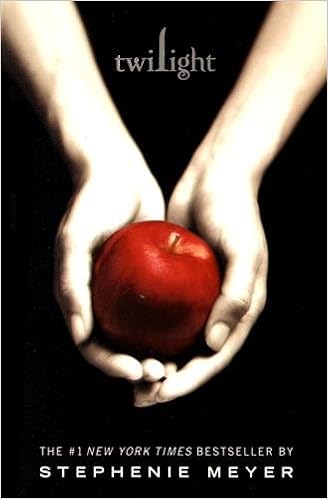
The cover of Twilight is stunning and evocative. Against a black backdrop, a pair of pale, graceful hands cradles a ruby red apple. The title is subtly emblazoned between strong forearms in silver script. This is a depiction from an actual scene in the book and movie. Adroit Edward catches an apple fumbled by bumbling Bella.  The image is also heavily metaphoric. An apple is easily bruised and battered, just like Bella. Not so while cradled in Edward’s marble arms. And let us not forget that an apple is the age-old symbol of the forbidden fruit, of temptation. Here, it stands not only for the temptation of first love and lust, but also for the temptations that the central characters are to each other. Edward must constantly resist his desire to make Bella at the very least, his most satisfying meal, or ultimately, to turn her so that she’ll join him in eternity. Bella avoids joining the Cullens, her strongest temptation, not through any effort on her part, but through the willpower of Edward and the rest of his preternaturally beautiful clan.


Never judge a book by its cover.


With classic themes similar to those in Romeo and Juliet, Beauty and the Beast, and Peter Pan,  and an ethereal, human-friendly family of vampires  as main characters (a trend in YA lit that won’t die, haha), this book had the potential for greatness. Unfortunately, it falls short of this potential. The writing is simultaneously awkward and overwrought. I found myself rolling my eyes and muttering “oh, please…” at Bella’s descriptions of Edward’s beauty, or at the happy couple’s proclamations of love. Bella’s emotional and physical ups and downs didn’t move me much. I found Edward and his family a bit more interesting, perhaps because they’re drop-dead gorgeous (haha) vampires.


I also found the book somewhat predictable, but this could have been because I saw the movie before reading it. This is one instance where the movie is slightly better than the book, probably because I enjoyed looking at the beautiful Pacific Northwest scenery. There is one stand-out scene in the movie: the baseball scene. I admit to exclaiming, “That is awesome!” when I first saw it. I love the music behind it and the whimsy of vampires playing baseball but only able to do so in a thunderstorm. I was eager to see how it was handled in the book. It was disappointing.

I don’t plan on reading the other books in this series, but there are two spinoffs I’d love to see: a book on Carlisle’s human history and early life as a vampire, authored by Anne Rice. I’d read a similar book on Alice, especially if it were written by Joe Hill.

Wednesday, April 19, 2017

Book Review: The Lacuna by Barbara Kingsolver

Hello Readers! Summer is right around the corner and you know what that means: Summer reading! Before you leave campus for the summer, the Library staff will offer you their own reviews of some of Kistler Library's newest books. If they sound good, add them to your own summer reading list!

Today, Elena Sisti, Reference Librarian at Kistler Library, has written her review for The Lacuna by Barbara Kingsolver, Call Number: PS3561 .I496 L33 2009. Hope you enjoy!


Review:
This is a story about words, spoken and unspoken, written and unwritten. This is a story about Harrison Shepherd, a private man of many talents who ends up in a rather public profession; he’s a best-selling novelist. One of the most compelling themes of this book is that what’s most important about a person is what you don’t know about him. At first these unknowns add to Shepherd’s allure and appeal. Later in the book, his blanks are filled in with perversions and untruths that devastate every part of his already agoraphobic life. 


Lacunae feature prominently in this story, both literally and figuratively. Shepherd would dive into a lacuna between rocks in the sea during for respite during his childhood in Mexico. The life Shepherd presents to the public is filled with lacunae. A journal kept during his young adulthood conveniently goes missing, a convenient excuse to avoid writing his memoirs, despite his beloved Mrs. Brown’s insistence that he do so anyway.

This book is a critique of the media. Newspaper and radio reports feed off of themselves, repeating and sensationalizing, filling in any lacunae with unverified facts until they become “truth.” This is reminiscent of the image in the book’s opening paragraphs. Shepherd and his mother cringe in fear of the sound of the howler monkeys’ dawn vocalizations outside the hacienda where they first lived in Mexico. One howler would set off the next. Even after it was explained to them that the monkeys were establishing their hunting territories, boy and mother remain uneasy. 

“Their food might be us, mother and son agreed. You had better write all this in your notebook… So when nothing is left of us but bones, someone will know where we went.”

Ironically, American newspapers and radio may only howl within a very limited range. The last third of the book takes place during the Red Scare and the time of McCarthy’s ominous Un-American Activities Committee. A narrow line separated “appropriate” expression from accusations of Communism. This line is especially narrow in the art world.

Such a myopic point of view angers Violet Brown. She argues that it is as if the powers that be believe America to be finished and perfect. Any hints that it could be improved or suggestions for progress are considered un-American. Any appreciation of different ideologies, behaviors or cultures is anti-American, therefore Communist, and therefore cause for investigation and legal persecution. This monster of an idea sometimes still rears its ugly head today.

I love that Frida Kahlo and Diego Rivera and their friend Lev Trotsky are major characters in this novel. The Riveras were Communist supporters, which didn’t affect them too much in Mexico, but did determine how and if their work was viewed in the United States.

Vivacious, vibrant, and often ill, Kahlo presents one of the novel’s most thought-provoking ideas: that the ancient Aztecs seem heroic to us moderns because they didn’t have written language. We don’t have any accounts of their quotidian struggles. All they left were their grand monuments, so we believe the that people themselves to be monumental; an example of the lacuna working in a culture’s favor.

Approximately 2/3 of this book takes place in Mexico. These are the parts that I love best. This setting allows Kingsolver to work her lyrical magic, describing the colors of the women’s clothes, the smells of the food and the flowers, raucous parties, and the light on the Aztec’s pyramids. For a time, Shepherd is employed as a cook and enjoys the task throughout his life. Kingsolver’s writing shines in her descriptions of food and belies her love of the topic.

I also enjoyed Shepherd’s first few years in Asheville, N.C. It seems very Arts and Craftsian and cozy. Despite WWII, America seems a hopeful place where everyone is united in doing their part for the war effort, as opposed to a few years later when there is much divisive finger-pointing as everyone is encouraged to rout out the Communists in their midst.

The passage entitled "On Your Leaving" are some of the most beautiful paragraphs I’ve ever read in a novel, a love letter that anyone should be delighted to receive.

The horticultural, special collections librarian and the Philadelphian in me were thrilled that Shepherd goes to the library with Romulus, the neighbor boy, to identify a wildflower using Bartram’s Flora of the Carolinas, which “had full-color plates of the specimen in question.” Romulus was disappointed to learn the true identity of said specimen.

I do think the book could have been a few dozen pages shorter, but overall, Kingsolver rightly maintains her position as Stephen King’s band- and shelf mate with this deep and rich novel.

Tuesday, October 25, 2016

Staff Tuesdays: Sarah Bolce, Evening/Weekend Supervisor

Every Tuesday during the Fall semester, we will be introducing, or re-introducing, you to the wonderful (and adorable) Library staff that work to help students make the most of their academic experiences here at Rosemont College. 


This week, we'd like to introduce Sarah Bolce, Evening/Weekend Supervisor.


As Evening/Sunday Supervisor, Ms. Bolce manages the Information Desk during Kistler Library's evening hours from 6pm to 11pm during the week. She also supervises the Library on Saturdays. She is responsible for checking items in and out and keeping the Library clean and quiet. Let's learn a little more about Sarah:

  1. If I run into you in the library, what would you typically be doing?

    I would be at the Circulation Desk ready to help students as needed.

  2. What is your favorite spot on campus, outside of the Library?

    I enjoy the walk from Kaul parking lot to the Library because I get to see the campus in all seasons as I'm heading to and from work. The library's Front Reading Room is my favorite spot in the Library, it's old-fashioned and impressive, while also being warm and welcoming. 
  3. Where do you spend most of your time while working in the Library?

    I spend most of my time in the Library behind the Circulation Desk.
  4. What do you like to do when you're not working?  
    In my free time I like work on my family’s genealogy to figure out who my ancestors were and where they came from, and learn about their lives.
  5. What is your favorite part about working in Kistler Library?

    My favorite part of working in Kistler Library is meeting, and talking with, the students who come into the library.
  6. What is a fun fact about yourself?

              I'm on level 1229 in Candy Crush.

Wednesday, October 19, 2016

Information Commons Exhibit: 2016 Presidential Lecturer, Chris Lowney

On Monday, October 24th, Rosemont's Institute for Ethical Leadership and Social Responsibility will sponsor a talk by the highly recognized author, Chris Lowney. Lowney will give the Presidential Lecture entitled "Doing the Laundry, Dirty Shoes, and the Monastery Bell Leadership Lessons from Pope Francis." With such an intruguing title, we are eager to hear his presentation.

Educated in the Jesuit tradition and for a time a Jesuit seminarian, he later entered the business world ultimately becoming a manager at J.P. Morgan, where he remained for seventeen successful years. Then after much thought, he decided to leave without a clue as to what he would be doing with the rest of his life. That issue was resolved when he started writing books and lecturing on leadership. His talks combine both his spiritual and worldly experiences in a captivating way.

To learn more about Chris Lowney, and Pope Francis, please stop by to see the Information Commons exhibit case on the first floor of Kistler Library.


Tuesday, October 4, 2016

Staff Tuesdays: Emily Siegel, Archives Assistant

Every Tuesday during the Fall semester, we will be introducing, or re-introducing, you to the wonderful (and adorable) Library staff that work to help students make the most of their academic experiences here at Rosemont College. 

This week, we'd like to introduce Emily Siegel, Archives Assistant.


As Archives Assistant, Ms. Siegel assists the Archivist with organizing and maintaining all the items in Rosemont College Archives. She works with the Archivist to help develop exhibits, both online and for the Archives display case in Kistler Library. She also works with Archives patrons both on and off-campus to find items or information about specific students and events in Rosemont's past. When she's not working in Rosemont College's Archives, she is working at the SHCJ Archives next to Gracemere. Let's learn a little bit more about Emily: 

If I run into you in the library, what would you typically be doing?

Setting up an exhibit on the main floor near the Front Reading Room


What is your favorite spot on campus, outside of the Library?

The garden outside of the library down the steps near the original entrance you can find me attempting to warm up from the cold Library.


Where do you spend most of your time while working in the Library?

Typically I’m in my office across from the upstairs lavatory


What do you like to do when you're not working?

Surprise surprise, I love to read (historical) fiction


What is your favorite part about working in Kistler Library?

I love to see the diligent work as students race to meet deadlines. It reminds me of my own college experiences at Rosemont.  


What is a fun fact about yourself?


I was planning to enter the US Air Force before I decided to attend college (at Rosemont).

Wednesday, September 21, 2016

Staff Tuesdays: Joseph Tresnan, Assistant Director of the Library

Every Tuesday during the Fall semester, we will be introducing, or re-introducing, you to the wonderful (and adorable) Library staff that work to help students make the most of their academic experiences here at Rosemont College. 


This week, we'd like to introduce Joseph Tresnan, Assistant Director of Library Services.


As Assistant Director, Mr. Tresnan assists the Director with the administrative responsibilities for the Library. He also works with the other Reference Librarians to assist students and faculty with their research, both at the Reference Desk in the library and in library instruction sessions for individual classes. When Joe is not working with the Director or at the Reference Desk, he manages all of Kistler Library's print and electronic resource subscriptions, including the subscriptions for our databases and electronic journals. Let's learn a little bit more about Joe: 

If I run into you in the library, what would you typically be doing?


  • I might be found at the information desk helping students with research, managing our periodicals and electronic resources, or looking for new books to add to our collection.

What is your favorite spot on campus, outside of the Library?


  • I like to walk down by the stream, especially when the geese are around.

What do you like to do when you're not working?


  • When I’m not working I enjoy reading, doing crossword puzzles, and watching way too much TV!

What is your favorite part about working in Kistler Library?


  • The best part of working in the Library is helping students with their research. They come up with some fascinating topics, and I love to learn right along with them.

What is a fun fact about yourself?


  • I would love to someday compete on Jeopardy!

Tuesday, September 13, 2016

Staff Tuesdays: Allison Sharkey, Reference and Archives Librarian

Every Tuesday during the Fall semester, we will be introducing, or re-introducing, you to the wonderful (and adorable) Library staff that work to help students make the most of their academic experiences here at Rosemont College. 


This week, we'd like to introduce Rosemont alumna, and keeper of the history of Rosemont College, Allison Sharkey, Reference and Archives Librarian.


As Reference and Archives Librarian, Ms. Sharkey works with the other Reference Librarians to assist students and faculty with their research, both at the Reference Desk in the library and in library instruction sessions for individual classes. Additionally, she manages all of the archives for Rosemont College. She is responsible for maintaining and organizing all sorts of items from Rosemont's past, such as yearbooks and newspapers, meeting minutes, photos, President's journals, even the old mascot costumes! Let's learn a little bit more about Allison:


 If I run into you in the library, what would you typically be doing? Most likely you’d run into me at the reference desk, as that’s where I’m able to stay put for long stretches of time. I like that my job keeps me busy and all over the library, but I also really enjoy getting some time to slow down at the reference desk and getting to interact with Rosemont students.
What is your favorite spot on campus, outside of the Library? Hands down the garden behind the library. I love sneaking out there on my lunch break to read.

Where do you spend most of your time while working in the Library? I’m all over the place-- I spend about half my time at the reference desk, and the other half is split between my office and the archives, both tucked behind the third floor stacks. I’m also teaching this semester so I can be found downstairs in room 107 too.

What do you like to do when you're not working? I love trying new restaurants and am so lucky to live in the foodie haven that is Philadelphia. I’ve been to 22 of this year’s top 50 restaurants in Philly, but I’ve got a lot of work to do before next year’s list comes out!

What is your favorite part about working in Kistler Library? The staff! We’re a really close knit group and really care about each other both personally and professionally. It really makes coming to work a joy when you care about the people you spend so much time with during the week.

What is a fun fact about yourself? I’m seriously really good at parallel parking- like better at it than normal parking lot parking. It’s a skill I picked up from living in Center City for so long.