Showing posts with label history. Show all posts

Tuesday, November 14, 2017

Dr. Gold's Connelly Lecture

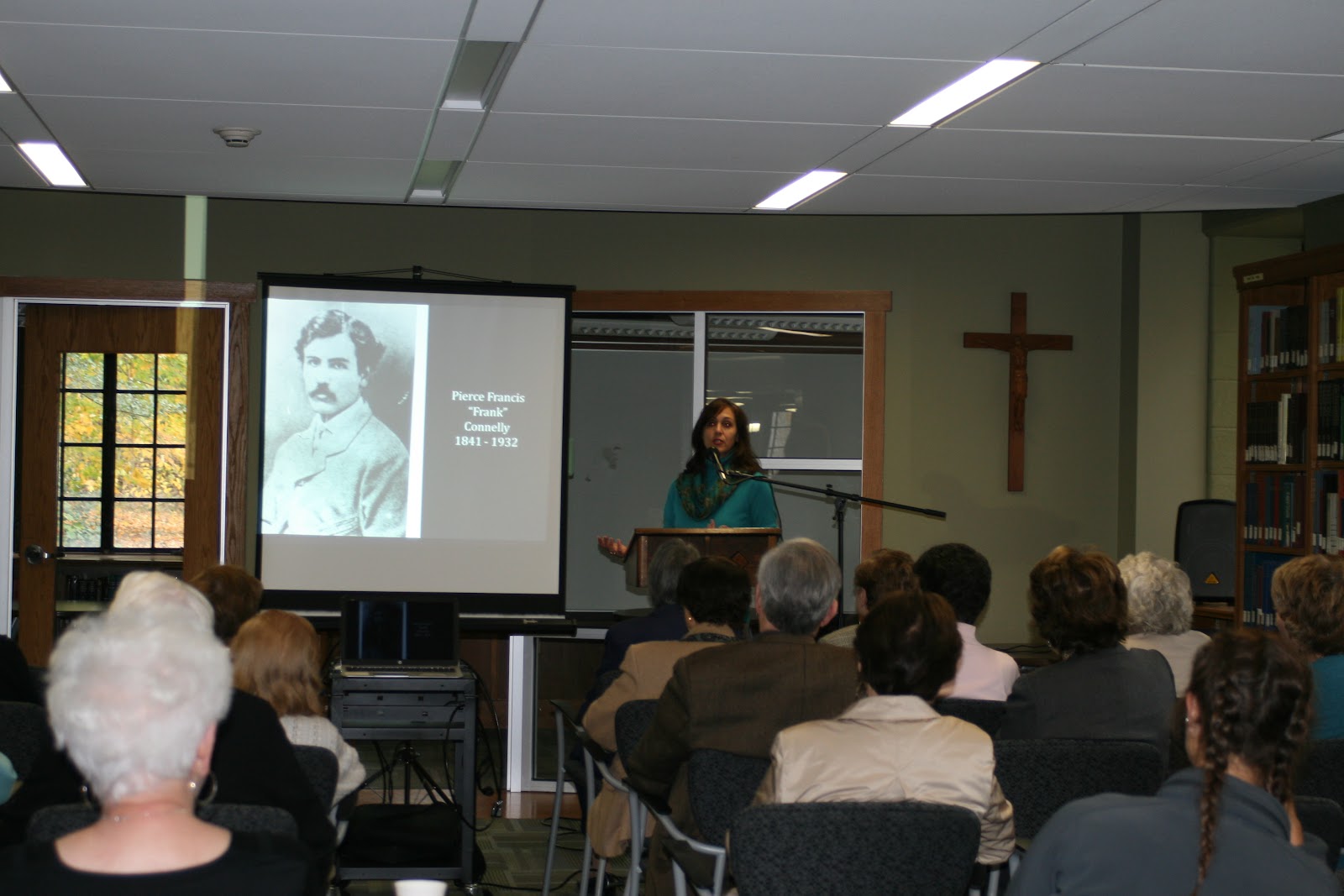
Pierce Connelly lecture 001.JPGOn Wednesday, November 1, we had the distinct pleasure of hosting Dr. Susanna Gold at the Gertrude Kistler Memorial Library at Rosemont College. She gave an informative lecture on the works of Pierce Francis “Frank” Connelly, son of Cornelia Connelly who was the foundress of the Society of the Holy Child of Jesus.
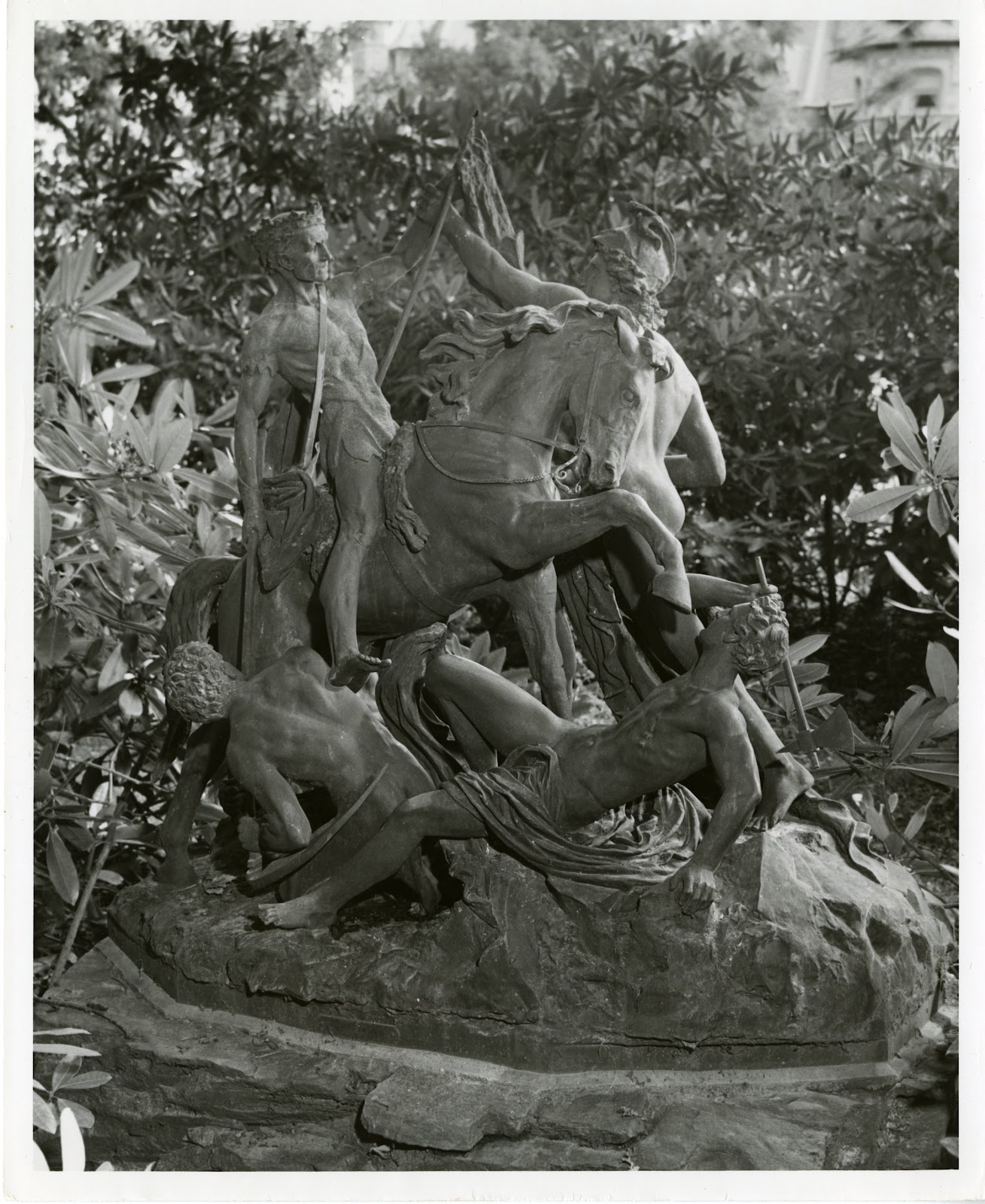
Dr. Gold laid out Frank’s journey through the arts in Italy as well as his entrance into the Centennial Exhibition in Philadelphia, PA in 1876. She discussed his works of art that were on display prominently at the Exhibition. The piece that drew the most interest was very different from the rest of Frank Connelly’s work. Most of his sculptures were neoclassical style, women sculptures, while the piece that was the focus of the talk was much different.  "Honor Arresting the Triumph of Death," is a group composition that features six different figures:  Death, Death’s horse, Strength, Courage, Perseverance and Hope. Dr. Gold discusses how this piece, unlike others at the exhibit that portrayed aspects of the Civil War in the United States of America, touched everyone and allowed for the focus on the sacrifice of human life rather than the sides of the war. Most of Connelly’s work was sold at this exhibition Dr. Gold noted, except for this one piece.  

An article in The Rambler relays the story of how the sculpture came to Rosemont college. In the summer of 1939, Rev. Mother Provincial and Rev Mother Ignatius traveled to Rome where the meet Frank's daughter, Mariana who later became Princess Borghese. She felt that the sculpture should be in the hands of the Society of the Holy Child Jesus and gifted it to Rosemont College. The sculpture has been in various places on the campus and is currently close to the science building.

If you would like to learn more about Frank Connelly or his work, schedule an appointment with our archives department or you can check out Dr. Gold's book The unfinished exhibition: Visualizing myth, memory and the Civil War in centennial America from the Gertrude Kistler Memorial Library.

Unknown. (1939, October 13). Princess Borghese presents statue: Group was executed by F.P.

Connelly. The Rambler.

Wednesday, January 14, 2015

A Brief History of the Chapel of the Immaculate Conception


Emily Siegel '14

Since the start of Rosemont College, there has been an obvious need for a campus chapel. Initially a makeshift chapel was set up in a room of Main Building. Then, in 1926, the chapel was moved to the basement of the recently completed Gertrude Kistler Memorial Library. Mother Mary Ignatius Carroll, SHCJ, second college president, was nicknamed “Ignatius the Builder” for her devotion to grow Rosemont’s campus saw it her duty to build a chapel. After struggling through the Great Depression, everyone on campus strove to see M.M. Ignatius’ dream actualized. 

Mother Mary Ignatius Carroll, SHCJ
The College finally received permission to construct a crypt in 1939 with hopes that it would eventually become a chapel after making numerous pleas for consent. M.M. Ignatius made the voyage to the Sisters of the Holy Child Jesus’ motherhouse in Rome and received permission for an ENTIRE chapel. Sadly, she did not survive the voyage back; however her dream for a Rosemont College Chapel was accomplished. On March 19, 1940, ground was broken, presided over by Cardinal Dennis Dougherty, Archbishop of Philadelphia, and Mother Mary Cleophas Foy, SHCJ, the College’s president. The Chapel of the Immaculate Conception was completed and dedicated on January 9, 1941.

The building was completed by Philadelphia Architects, Henry D. Dagit & Sons, while Matthew McCloskey & Company were builder and general contractors. The Chapel was constructed in a cruciform shape, set on the traditional east-west axis. The exterior walls are a combination of local Foxcraft stone, trimmed with Indiana limestone. The roof is constructed of steel and concrete slabs covered with Vermont slate in shades of grey and green. Above the entry to the vestibule there is a limestone statue of the Immaculate Conception. The tower houses the Chapel bell, which was a gift from Miss Mary Clare, friend, benefactor, and trustee to the College. 

The outer doors are of oak and just above the front door is a bas-relief representing the Descent of the Holy Ghost.   The interior walls are limestone and the construction is based on the stone vaulting of the centuries old cathedrals and churches in Europe. The main altar was originally located at the back wall of the apse but was later moved, in 1969, to be more central following the changes made to churches and chapels by the Second Vatican Council. The Chapel’s crypt, or basement, was named St. Joseph’s Hall, and now houses offices and Campus Ministry. 

The stained glass windows have always been considered one of the most glorious parts of the Chapel, if not all of campus. The windows were designed and produced by the Willet Stained Glass Studios, in Germantown, PA. The Chapel of the Immaculate Conception is among the few in America to focus on the depictions of female saints. The sisters involved with the selection of the saints all considered how each depiction would impact the lives of students to come. 

For more information on the history of the Chapel of the Immaculate Conception, arrange an appointment by emailing  archives@rosemont.edu. Stop by the Gertrude Kistler Memorial Library and view  more photos displayed by the Rosemont Archives. Also, don’t forget to attend the Sunday, January 25th event, “The Windows of the Chapel of the Immaculate Conception,” beginning at 3 p.m. to learn more about the Windows’ stories, imagery, and meanings.

Friday, September 19, 2014

Who was Gertrude Kistler?

By Emily Siegel '14

Take a break from the onslaught of new information to familiarize yourself with the Gertrude Kistler Memorial Library and consider some less serious information.  Get to know the girl for whom this building was named.


Gertrude Kistler was the daughter of Bertha and Sedgwick Kistler, two Pennsylvania natives. Born in 1908, Gertrude lived with her parents in Philadelphia while she attended St. Leonard’s Academy, a Holy Child school once located in West Philadelphia. During the summer of 1920, the family was struck with tragedy while on vacation sightseeing in the West. On July 7, 1920, the 12 year old Gertrude drowned in the fast flowing Merced River that runs through the valley of Yosemite National Park. H.J. Pink, the Los Angeles chauffer who was with her at the time, also lost his life in an attempt at her rescue.

                Less than 5 years after Gertrude’s death, Mr. and Mrs. Kistler reached out to Rosemont's president at the time, Mother Mary Ignatius Carroll, SHCJ, and shared their interest in memorializing their lost daughter by providing the campus with a new building. Their offer fit the campus’ growing need for an actual library facility, as the one located in Main Building was no longer large enough for the college’s growing collection. That same year the family announced their gift, a number of Gertrude’s St. Leonard’s classmates entered the college as freshman. The Kistlers turned personal tragedy into a gift for future generations. Remnants of Gertrude’s life can still be found around the library; her portrait and personal desk can be found in and near the Front Reading Room.