Showing posts with label Book Reviews. Show all posts

Wednesday, September 27, 2017

Book Review: Twilight by Stephanie Meyer

In honor of Banned Books Week, Elena Sisti (Reference Librarian) has written a review of the book Twilight by Stephanie Meyer. This is just one of the many books that has been challenged during the last few years and Elena shares her thoughts on the book and how it compares to the movie.

Twilight, Stephanie Meyer, FIC MEY
reviewed by Elena Sisti
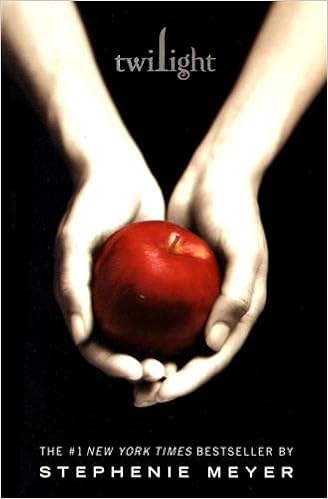

The cover of Twilight is stunning and evocative. Against a black backdrop, a pair of pale, graceful hands cradles a ruby red apple. The title is subtly emblazoned between strong forearms in silver script. This is a depiction from an actual scene in the book and movie. Adroit Edward catches an apple fumbled by bumbling Bella.  The image is also heavily metaphoric. An apple is easily bruised and battered, just like Bella. Not so while cradled in Edward’s marble arms. And let us not forget that an apple is the age-old symbol of the forbidden fruit, of temptation. Here, it stands not only for the temptation of first love and lust, but also for the temptations that the central characters are to each other. Edward must constantly resist his desire to make Bella at the very least, his most satisfying meal, or ultimately, to turn her so that she’ll join him in eternity. Bella avoids joining the Cullens, her strongest temptation, not through any effort on her part, but through the willpower of Edward and the rest of his preternaturally beautiful clan.


Never judge a book by its cover.


With classic themes similar to those in Romeo and Juliet, Beauty and the Beast, and Peter Pan,  and an ethereal, human-friendly family of vampires  as main characters (a trend in YA lit that won’t die, haha), this book had the potential for greatness. Unfortunately, it falls short of this potential. The writing is simultaneously awkward and overwrought. I found myself rolling my eyes and muttering “oh, please…” at Bella’s descriptions of Edward’s beauty, or at the happy couple’s proclamations of love. Bella’s emotional and physical ups and downs didn’t move me much. I found Edward and his family a bit more interesting, perhaps because they’re drop-dead gorgeous (haha) vampires.


I also found the book somewhat predictable, but this could have been because I saw the movie before reading it. This is one instance where the movie is slightly better than the book, probably because I enjoyed looking at the beautiful Pacific Northwest scenery. There is one stand-out scene in the movie: the baseball scene. I admit to exclaiming, “That is awesome!” when I first saw it. I love the music behind it and the whimsy of vampires playing baseball but only able to do so in a thunderstorm. I was eager to see how it was handled in the book. It was disappointing.

I don’t plan on reading the other books in this series, but there are two spinoffs I’d love to see: a book on Carlisle’s human history and early life as a vampire, authored by Anne Rice. I’d read a similar book on Alice, especially if it were written by Joe Hill.

Wednesday, April 19, 2017

Book Review: The Lacuna by Barbara Kingsolver

Hello Readers! Summer is right around the corner and you know what that means: Summer reading! Before you leave campus for the summer, the Library staff will offer you their own reviews of some of Kistler Library's newest books. If they sound good, add them to your own summer reading list!

Today, Elena Sisti, Reference Librarian at Kistler Library, has written her review for The Lacuna by Barbara Kingsolver, Call Number: PS3561 .I496 L33 2009. Hope you enjoy!


Review:
This is a story about words, spoken and unspoken, written and unwritten. This is a story about Harrison Shepherd, a private man of many talents who ends up in a rather public profession; he’s a best-selling novelist. One of the most compelling themes of this book is that what’s most important about a person is what you don’t know about him. At first these unknowns add to Shepherd’s allure and appeal. Later in the book, his blanks are filled in with perversions and untruths that devastate every part of his already agoraphobic life. 


Lacunae feature prominently in this story, both literally and figuratively. Shepherd would dive into a lacuna between rocks in the sea during for respite during his childhood in Mexico. The life Shepherd presents to the public is filled with lacunae. A journal kept during his young adulthood conveniently goes missing, a convenient excuse to avoid writing his memoirs, despite his beloved Mrs. Brown’s insistence that he do so anyway.

This book is a critique of the media. Newspaper and radio reports feed off of themselves, repeating and sensationalizing, filling in any lacunae with unverified facts until they become “truth.” This is reminiscent of the image in the book’s opening paragraphs. Shepherd and his mother cringe in fear of the sound of the howler monkeys’ dawn vocalizations outside the hacienda where they first lived in Mexico. One howler would set off the next. Even after it was explained to them that the monkeys were establishing their hunting territories, boy and mother remain uneasy. 

“Their food might be us, mother and son agreed. You had better write all this in your notebook… So when nothing is left of us but bones, someone will know where we went.”

Ironically, American newspapers and radio may only howl within a very limited range. The last third of the book takes place during the Red Scare and the time of McCarthy’s ominous Un-American Activities Committee. A narrow line separated “appropriate” expression from accusations of Communism. This line is especially narrow in the art world.

Such a myopic point of view angers Violet Brown. She argues that it is as if the powers that be believe America to be finished and perfect. Any hints that it could be improved or suggestions for progress are considered un-American. Any appreciation of different ideologies, behaviors or cultures is anti-American, therefore Communist, and therefore cause for investigation and legal persecution. This monster of an idea sometimes still rears its ugly head today.

I love that Frida Kahlo and Diego Rivera and their friend Lev Trotsky are major characters in this novel. The Riveras were Communist supporters, which didn’t affect them too much in Mexico, but did determine how and if their work was viewed in the United States.

Vivacious, vibrant, and often ill, Kahlo presents one of the novel’s most thought-provoking ideas: that the ancient Aztecs seem heroic to us moderns because they didn’t have written language. We don’t have any accounts of their quotidian struggles. All they left were their grand monuments, so we believe the that people themselves to be monumental; an example of the lacuna working in a culture’s favor.

Approximately 2/3 of this book takes place in Mexico. These are the parts that I love best. This setting allows Kingsolver to work her lyrical magic, describing the colors of the women’s clothes, the smells of the food and the flowers, raucous parties, and the light on the Aztec’s pyramids. For a time, Shepherd is employed as a cook and enjoys the task throughout his life. Kingsolver’s writing shines in her descriptions of food and belies her love of the topic.

I also enjoyed Shepherd’s first few years in Asheville, N.C. It seems very Arts and Craftsian and cozy. Despite WWII, America seems a hopeful place where everyone is united in doing their part for the war effort, as opposed to a few years later when there is much divisive finger-pointing as everyone is encouraged to rout out the Communists in their midst.

The passage entitled "On Your Leaving" are some of the most beautiful paragraphs I’ve ever read in a novel, a love letter that anyone should be delighted to receive.

The horticultural, special collections librarian and the Philadelphian in me were thrilled that Shepherd goes to the library with Romulus, the neighbor boy, to identify a wildflower using Bartram’s Flora of the Carolinas, which “had full-color plates of the specimen in question.” Romulus was disappointed to learn the true identity of said specimen.

I do think the book could have been a few dozen pages shorter, but overall, Kingsolver rightly maintains her position as Stephen King’s band- and shelf mate with this deep and rich novel.